Skill based casino games (blackjack, video poker, and a handful of newer skill-slot hybrids) reward a player’s decisions in a way standard slots never do. Esports research shows reaction-time training genuinely improves choice speed and hand-eye coordination in gamers. None of that changes the math sitting underneath. Skill narrows the house edge. The house still keeps most of it.
What Actually Makes a Casino Game “Skill-Based”?
A game counts as skill-based when a player’s choices meaningfully determine the outcome. Randomness may be involved in the mechanism. Player decisions still drive the result, and that split runs through every casino game on the floor.
Standard slots sit in one camp. Every spin runs through an RNG independent of the last one, regardless of which software studio built the game; there’s no decision to make beyond how much to bet and when to press the button. Blackjack sits in the other camp, and it’s the clearest example of a hybrid game: the cards are dealt randomly, but what you do with them (hit, stand, double, split) is entirely up to you. Play every hand by basic strategy and the house edge drops dramatically on a standard payout table. Play by gut feel instead, and that edge climbs back toward much worse odds for players.
Video poker gets filed under “skill-based” too, and that’s mostly fair, but it’s more RNG-driven than a lot of players expect. You’re choosing which five cards to hold and which to discard, which is a real decision with a right and wrong answer for every hand. The randomness, though, is doing more of the work than the strategy chart makes it feel like. Get the discard decision wrong often enough and the return drifts down toward a plain slot machine’s numbers, just dressed up as a card game.
Where Does Reaction Time Actually Matter at the Table?
Reaction time matters wherever a game puts a clock, explicit or implicit, on your decision. At a live blackjack table, dealers move at a pace; hesitate too long on every hand and you’ll either slow the game to a crawl or start making rushed, worse decisions under social pressure. Some video poker machines and most digital blackjack interfaces run on a soft timer too, and under a visible clock, slower players often lean on whichever choice feels safe, skipping the strategy chart in the moment.
Compare that to a standard slot spin. Speed changes nothing there. You can hit the spin button in 0.2 seconds or think about it for ten minutes, and the RNG behind that spin was already determined the instant you pressed it. How fast you reacted to the reels stopping had no bearing on it. Reaction time only has a job to do in games where the human is inserting a decision into the sequence. Everywhere else, it’s decoration.

What Does the Reaction-Time Training Research Actually Show?
The research on reaction-time training is real. It comes from gaming and esports labs, a different setting from a casino floor, and that distinction matters. A randomized online study by Ziv and colleagues, run in 2022, tested 131 participants. Gamers who played more than 10 hours a week showed significantly faster choice-reaction-time and Simon-task scores than non-gamers, along with better working-memory performance on digit-span tests.
Training studies point the same direction. Lachowicz and colleagues ran a 2024 randomized controlled trial with 66 amateur e-athletes, using VR headsets and a Beat Saber-style progression system. Short-term training significantly improved eye-hand coordination, and the effect was still measurable a month later. A separate 2024 cross-sectional study looked at reaction testing across two groups. Cyma-Wejchenig and colleagues found that 36 esports players reacted meaningfully faster than 25 non-players on the same standardized test.
None of these three studies put anyone at a blackjack table or a video poker machine. They measured reflexes and coordination in gaming contexts. Faster, more trained decision-making could plausibly carry over into games that reward quick, correct choices. Nobody has run the equivalent study on card-game decision speed, so the overlap between esports research and casino skill games remains a hypothesis, still untested directly.
Skill-Based Slot Machines: How Much Control Do You Really Have?
Skill-based slot machines exist because regulators went looking for them; the demand didn’t start with players asking for a new game type. Nevada’s SB9, passed in 2015, directed state gaming regulators to write rules permitting “skill-based and arcade-like” features inside slot-style machines, and the stated goal was attracting younger players who grew up on video games, a generation arcade-style machines were built to appeal to. GameCo and Gamblit Gaming became the lead manufacturers chasing that market. Gamblit’s TriStation, a three-seat cabinet running six different skill-based games, landed on Las Vegas casino floors as one of the category’s flagship installations.
On almost every skill-based slot, your skill only touches the bonus round, a detail that marketing copy tends to skip. The base reel spin underneath it stays fully RNG, identical in mechanism to a standard slot machine. A timing challenge or matching mini-game sits on top of that spin, and that’s the only part a player’s reflexes can influence.
The advertised return figure compounds the confusion. It’s calculated at the highest achievable skill level in that bonus round, meaning the number on the cabinet assumes expert-tier play every single time. A below-expert player, which is most players, will not realize that advertised return. The category itself offers a useful caution. Skill-based slots have remained a niche market, and GameCo ran into commercial trouble after its early push, which industry observers treat as evidence that the technology never became the reel-replacing wave manufacturers pitched.
The Real Numbers: How Much Does Skill Actually Move the Odds?
Skill moves the numbers. The size of that movement depends entirely on which game and which pay table you’re looking at.
| Game | Skill component | Edge/RTP with optimal skill | Notes |
|---|---|---|---|
| Blackjack, 3:2 payout | Hit/stand/double/split decisions (basic strategy) | House edge ~0.5% | Assumes basic strategy played exactly; deviations push the edge back toward the casino |
| Video poker, 9/6 Jacks or Better | Which cards to hold or discard | 99.54% RTP with perfect strategy | Simplified strategy drops it to 99.46%, a loss of roughly 0.08% for slightly casual play |
| Video poker, 6/5 Jacks or Better | Same decision, weaker pay table | 95.00% RTP even with perfect strategy | The pay table downgrade matters more than any skill improvement can offset |
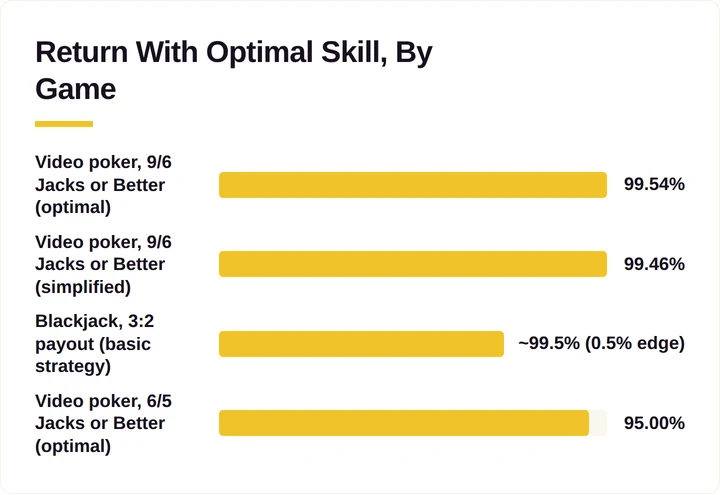

Basic strategy in blackjack and perfect strategy in video poker produce different house-edge numbers, because the two games run on different mechanics entirely. The pay table you sit down at often matters more than how sharp your decisions are. A weak pay table can outweigh superior strategy execution.
Why “I Have Fast Reflexes” Isn’t a Betting Edge
Feeling in control of a game and actually controlling its outcome are two different things, and the gap between them has been studied since long before video poker existed. Ellen Langer’s 1975 experiments found that people who picked their own lottery numbers rated their odds of winning as higher than people who were handed random numbers, even though the odds were mathematically identical either way. That gap between felt control and actual control became known as the illusion of control, and it’s been applied to gambling behavior in the decades since.
Reaction time can sit inside that same illusion if you’re not careful about what it’s actually doing. Reacting fast to a video poker hand or a blackjack decision point can absolutely help you execute correct strategy without hesitation-driven mistakes. It does nothing to change the cards you’re dealt, the deck’s underlying probabilities, or the pay table printed on the machine. A trained esports reflex applied to a weak-paying machine still leaves you at a disadvantage. Speed makes you execute strategy more cleanly. It doesn’t change the mathematical house edge.
Practical Takeaway for Reaction-Time and Esports Training
If reaction-time or esports training is already part of your routine, there’s a narrow, defensible application. It may reduce hesitation errors in games where you’re already using a known-correct strategy, like blackjack basic strategy or a video poker strategy chart. Faster, calmer decision-making under a soft time pressure means fewer moments spent defaulting to whatever choice feels safest under pressure.
It won’t do more than that.
It won’t turn a negative-expected-value game positive, it won’t change a pay table, and it does nothing whatsoever on a standard slot spin, where no decision exists for your reaction time to improve. Trained reflexes execute a strategy you already know cleanly. The strategy is what carries the value; speed is secondary.
A Quick Responsible-Gambling Note
Casino games, skill-based or not, are still built with a house edge, and that’s true even at a 3:2 blackjack table played by the book. If gambling stops feeling like entertainment with a cost attached, provincial responsible-gambling resources are available across Canada and worth using before the habit outpaces the bankroll. This article is for readers 18 and older, in line with the legal gambling age requirements that apply in most Canadian provinces.
FAQ
Is blackjack really a skill-based casino game, or is it mostly luck?
It’s a hybrid. The cards dealt are random. What you do with them is a separate decision entirely, and basic strategy decisions on every hand bring the house edge down significantly on a standard table, which is much better than guessing.
Does faster reaction time actually help in video poker?
It can help you execute a discard strategy without hesitation. Strategy still matters more than speed. A weak pay table will underperform even with perfect, rapid decisions. See the Real Numbers table for the specific impact of different machines.
Can esports or reaction-time training make me better at slots?
No, not on standard slots. There’s no decision point for faster reflexes to improve; the RNG determines the outcome the instant you spin, regardless of reaction speed.
What about skill-based slot machines specifically, do reflexes matter there?
Only in the bonus round. The base reel spin on skill-based slots stays fully RNG, and the advertised return is calculated at the highest achievable skill tier, so most players won’t hit that number even with strong reflexes.
Is feeling “in control” of a casino game the same as having an edge?
No. Research on the illusion of control, going back to Ellen Langer’s 1975 experiments, shows people consistently overestimate their odds when they feel involved in an outcome, even when the underlying probability hasn’t changed at all.